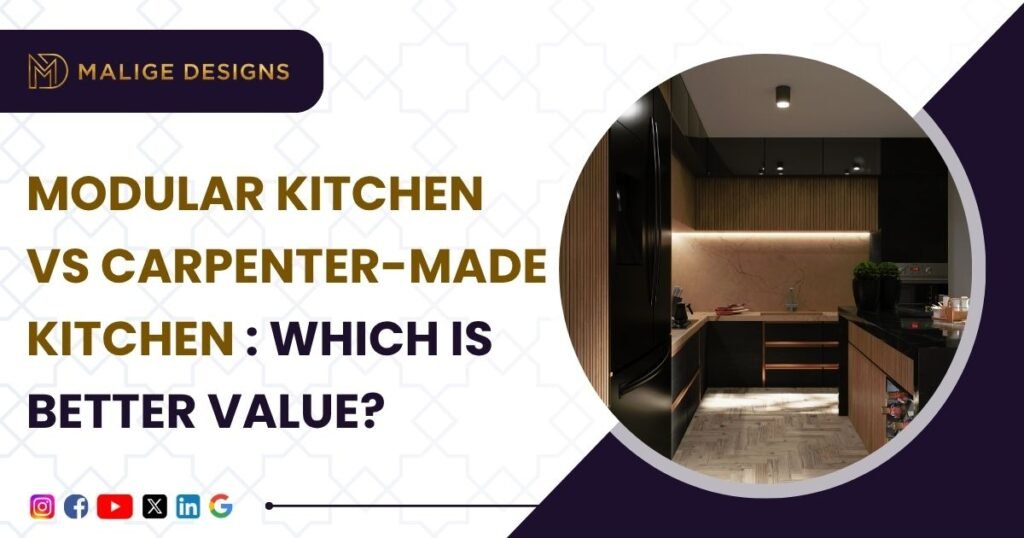
If you’re designing or renovating a kitchen in Bangalore, this is usually the first real decision you’ll face – go modular, or hire a skilled carpenter?
Both can genuinely deliver a functional, good-looking kitchen.
They just work differently in process, finish consistency, flexibility, and cost, and the right answer depends on your apartment layout, cooking habits, and budget more than it depends on which option is objectively “better.”
What a Modular Kitchen Actually Is
A modular kitchen is built from pre-manufactured cabinet units, designed to precise dimensions in 3D software, machine-cut in a factory, and assembled on-site.
Every base unit, wall unit, drawer, and accessory is produced with consistent quality using CNC machinery, and hardware comes from standardized certified brands – Hettich, Hafele, Blum – so quality doesn’t vary from one cabinet to the next.
What a Carpenter-Made Kitchen Actually Is
A carpenter-made kitchen is built entirely on-site from raw plywood or blockboard, cut and assembled by hand, and finished with laminate or paint applied where it’s installed.
This has been the standard approach in Indian homes for decades, and for good reason – a skilled carpenter can adapt on the spot to unconventional layouts, odd wall angles, or unique design requests in ways a rigid pre-set module sometimes can’t.
Build Quality and Precision
Factory-cut modular panels hit millimeter-level accuracy, with every edge machine-sealed so there’s no exposed raw surface where moisture can get in. The finish and joint quality stay consistent across every cabinet in the kitchen.
Carpenter-made kitchens depend heavily on the individual worker’s skill – a genuinely experienced carpenter can adjust dimensions on-site for uneven walls or non-standard plumbing positions in a way a factory module can struggle with, but that flexibility comes with more variability in outcome depending on who’s actually doing the work.
Durability in Bangalore’s Climate
Bangalore’s humidity, especially through monsoon, is a real factor for kitchen cabinetry specifically, given the combination of cooking steam and sink-area splashing. Modular kitchens typically default to BWR or BWP-grade plywood with factory-sealed edges, which handles that humidity well without any extra specification required.
A carpenter-built kitchen can hold up just as well – but only if BWR-grade plywood, quality laminate, and proper edge sealing are specifically requested upfront rather than left to whatever the carpenter defaults to. This is really the core difference: modular durability is built into the process by default, while carpenter durability depends on the homeowner knowing to ask for the right materials specifically.
Design and Layout Flexibility
Modular kitchens follow a structured design process – a 3D layout showing cabinet placement, countertop material, and appliance positions before anything is cut, typically built around standard shapes (L-shaped, U-shaped, parallel, straight, island) optimized for the kitchen work triangle.
Carpenter kitchens are where genuine customization shines – a built-in masala shelf, a specific rice container size, cabinetry that wraps around an existing gas pipe position – things that fall outside standard module dimensions. For unconventional layouts or very specific Indian cooking setups, this adaptability is real and valuable.
It’s worth noting, though, that a properly laser-measured modular process closes much of this gap. When a design is built around an actual 3D scan of the site rather than a generic template, modular cabinetry can accommodate uneven walls and odd corners far better than the “rigid” reputation modular sometimes carries.
Storage and Accessories
Modular systems come with a wide range of factory-designed internal accessories – corner carousels, pull-out pantry towers, cutlery organizers, bottle pullouts, magic corners – built to fit precisely within standard cabinet dimensions.
The same accessories can be fitted into carpenter-made cabinets when measured and installed properly, and many homeowners land on a genuine hybrid – custom-sized carpenter cabinets fitted with branded modular hardware, combining flexible sizing with modern functionality.
Cost Comparison
For a standard 2BHK kitchen in Bangalore, a well-made carpenter kitchen typically runs Rs 1.5-3 lakhs depending on plywood grade, laminate quality, and hardware used – a genuinely accessible entry point for a wider range of budgets. A modular kitchen for the same layout typically runs Rs 2.5-5 lakhs depending on finish (laminate, acrylic, or PU), hardware brand, and included accessories, with the higher price reflecting factory precision and structured warranty coverage.
Both can deliver real long-term value at their respective price points. A well-built carpenter kitchen with quality materials specified upfront can last 10-15 years; a modular kitchen with premium hardware and factory-sealed construction can last 15-20 years. In both cases, longevity comes down to material quality and execution, not the construction method alone.
Warranty and Support
This is where the two paths diverge most clearly. Working through a professional interior design firm – modular or carpenter-built – typically comes with a structured, written warranty covering materials, hardware, and workmanship. Working with an independent carpenter directly usually means an informal, verbal warranty at best, which is harder to actually enforce years later if something goes wrong.
Which Should You Choose?
Modular works best if you want a structured design process with a 3D preview upfront, consistent factory finish quality, and a kitchen built around a standard layout – a strong fit for newer apartments in gated communities across Sarjapur, Whitefield, Electronic City, and Yelahanka, where layouts tend to be fairly standardized to begin with.
Carpenter-made works best if you have a genuinely unconventional layout, very specific cooking requirements, or want hands-on input during the build itself – often the better fit for independent houses or older apartments with non-standard dimensions.
A hybrid approach works best if you want custom-sized cabinetry with modern branded hardware and accessories – combining flexible sizing with dependable functionality.
The Bottom Line
Neither approach is universally better – the right choice depends on your specific layout, cooking habits, and how much you value structured process versus hands-on flexibility.
What we’ve built at Malige Designs is a modular process specifically designed to close the flexibility gap – every project starts with a laser-measured site scan, not a generic template, so odd corners and non-standard walls get accounted for before manufacturing, not worked around afterward.
That’s paired with the consistency and warranty backing that only comes from controlling our own factory.