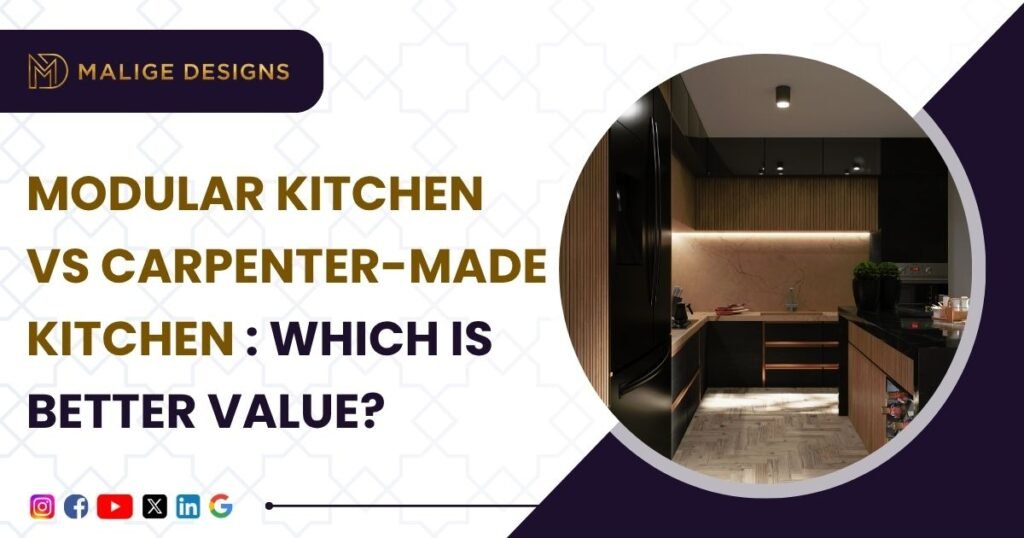
“Modular” gets used constantly across Bangalore’s real estate and design world, but most homeowners have never actually seen what happens between “design approved” and a finished wardrobe arriving at their door.
Understanding the engineering behind modular furniture changes how you evaluate a quote – because the difference between two “modular” companies often comes down entirely to what’s happening inside that process.
The Four-Stage Lifecycle
Every modular unit goes through the same basic sequence, whether it’s a kitchen cabinet or a wardrobe : digital design tailored to your exact room, automated factory production where panels are cut, drilled, and edge-banded, protected flat-pack transit to your site, and clean mechanical assembly on location. The quality gap between vendors almost always shows up in stage two – how well the factory production is actually controlled.
The Anatomy of a Module
Look past the laminate or acrylic finish and every modular unit is built from three distinct layers, each doing a different structural job.
1. The core substrate (the body). Unlike traditional carpentry, which often relies on generic commercial blockboard, modular manufacturing uses engineered core materials matched to where they’ll sit:
- HDHMR (High-Density High-Moisture Resistant) board – a strong choice for Bangalore kitchens and bathrooms, built to resist water vapor and humidity spikes
- BWP marine plywood – the standard for genuinely wet zones, engineered against layer separation even under sustained water exposure
- Commercial plywood or MDF – well suited to dry zones like bedroom wardrobes, study desks, and media consoles
2. The protective finish (the shell). The core gets sealed with a finish chosen for both protection and look – high-gloss acrylic for a modern, reflective finish that makes compact rooms feel larger, anti-fingerprint matte for high-touch surfaces that need to stay smudge-free, or high-pressure laminate for a durable, scratch-resistant surface available in a huge range of textures.
3. The functional hardware (the joints). This is the part that determines whether a unit still works smoothly in year eight, not just on day one. Certified hardware brands like Blum, Hettich, and Hafele use machine-calibrated dowels, cam locks, and soft-close hydraulic systems instead of basic screws, which is what keeps drawers and doors gliding evenly for years rather than months.
Why This Engineering Matters Specifically in Bangalore
Zero on-site construction mess. Traditional carpentry turns a home into an active workshop for months – fine wood dust settles into fresh paint, clogs window tracks, and tends to strain relationships with neighbors in a high-rise society. Because modular components arrive pre-finished in flat-pack boxes, on-site work is limited to mechanical assembly, not cutting or sanding.
Real resistance to Bangalore’s weather swings. Manual gluing during site carpentry leaves micro-gaps where moisture can work into a panel over time, causing warping. Industrial edge-banding, fused at over 200°C, creates a genuinely sealed, hydrophobic edge with no visible joint – a meaningfully different standard from what a hand-applied edge can achieve, especially through a full monsoon season.
Millimeter precision for compact layouts. In tighter floor plans across Whitefield, Varthur, and Sarjapur, every inch matters. CNC-processed panels are cut to mathematical accuracy, which is what makes smart storage integrations – corner carousels, hidden pull-out pantries, full-height sliding wardrobe tracks – actually work without misalignment.
| | Traditional Carpentry | Engineered Modular |
|---|
| Cutting method | Hand-cut with manual saws | CNC machine-processed |
| Joinery | Visible nails, wood glue | Seamless minifix fasteners |
| Shelving | Fixed, non-adjustable | Fully adjustable slots |
| Timeline | 60-90 days of on-site work | 7-10 days of clean assembly |
Three Myths Worth Correcting
“Modular can’t be customized.” The manufacturing process is standardized, but the layout isn’t – modules adjust in height, width, and depth to fit your actual floor plan, including odd corners, columns, or structural beams that a fixed showroom unit never accounts for.
“It’s weaker than solid carpentry.” Hand-hammered nails loosen under repeated daily stress over time. Modular furniture is held together with high-tensile fasteners, dowels, and cam-locks engineered to distribute weight evenly, which generally makes it more resistant to sagging, not less.
“You can’t move it if you relocate.” Because modular units are assembled with non-permanent fasteners rather than nailed into place, the entire system can be disassembled, flat-packed, and reassembled in a new home – something built-in carpentry structurally cannot do.
The Bottom Line
The word “modular” tells you almost nothing on its own – what matters is the engineering behind it: the specific core material, how the edges are sealed, and which hardware brand handles the moving parts.
This is exactly the level of detail we walk every client through before manufacturing begins at the MALIGE DESIGNS factory, because the quote should reflect the actual build, not just the word “modular” on a brochure.