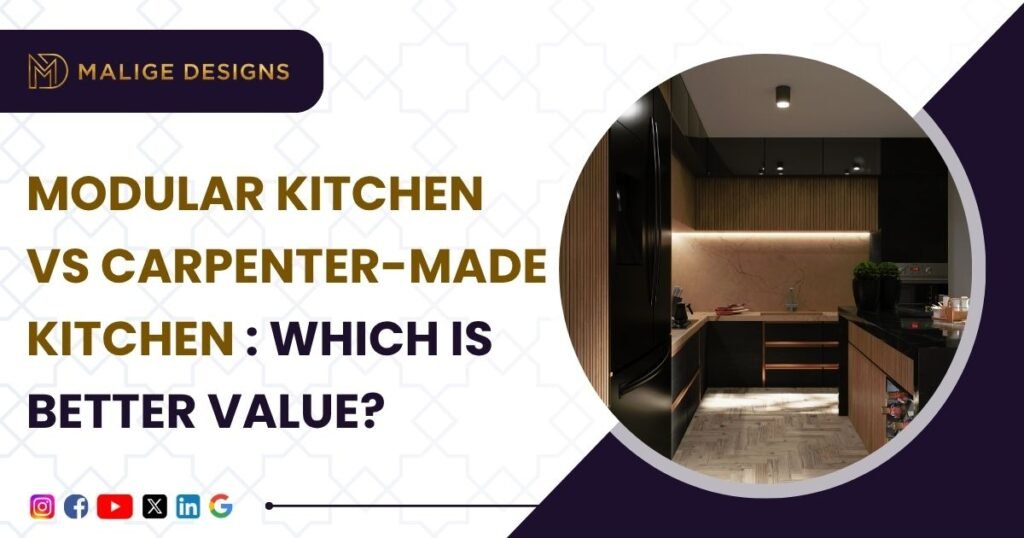
Most homeowners planning interiors focus first on aesthetics – the right shade of charcoal matte for the kitchen, the right walnut grain for the wardrobes.
The real measure of an interior investment, though, is how well it holds up under years of actual daily use, not how it looks on handover day.
In a humid, fast-paced city like Bangalore, cabinetry takes constant stress – slamming doors, heavy cookware, kitchen steam, seasonal humidity swings – and that’s exactly where the gap between hand-built and machine-engineered furniture shows up.
Here’s the mechanical reasoning behind why modular furniture consistently outperforms on-site carpentry on durability, not just on day-one finish.
1. Edge Sealing : Where Moisture Damage Actually Starts
The single most common reason woodwork fails is moisture getting into the core through an unsealed edge – and how that edge is sealed makes almost the entire difference in how long a panel lasts.
A local carpenter typically bonds PVC edge-band to a panel by hand, using a roller and standard cold glue. Because hand pressure is never perfectly even, microscopic gaps get left beneath the tape.
Over a few seasons of temperature swings, that cold glue dries out and cracks, and moisture works its way into those gaps – which is exactly what causes edges to peel and cabinet bases to swell a couple of years in.
Factory edge-banding uses a completely different process. Industrial through-feed machines apply adhesive at temperatures above 200°C, melting it into a liquid state before pressing the edge-band onto the panel under computer-controlled pressure.
The result is a zero-joint, genuinely hydrophobic seal – not tape applied to a surface, but a bonded extension of the panel itself that blocks moisture out permanently rather than temporarily.
2. Joinery : What Actually Holds the Structure Together
A wardrobe or kitchen cabinet is a load-bearing structure, and the joints holding it together take real mechanical stress every time a drawer opens or a heavy pot goes into a cabinet.
Manual carpentry typically relies on hammered nails or screws driven directly into the wood grain. That force splits internal plywood fibers at the point of entry, which weakens the joint from the very first day – and as doors and drawers get used over years, those nails gradually work loose, causing sagging and wobble.
Machine-cut modular furniture uses CNC-bored dowels and high-tensile steel cam-locks instead. Drilling centers bore these holes with millimeter-perfect depth and alignment, which distributes weight evenly across pre-machined load points rather than concentrating stress at a single nail.
It’s also a mechanical joint rather than a permanent one, which is part of why modular units can be disassembled and reassembled cleanly if you relocate – something a nailed structure simply can’t do.
3. Hardware Alignment : The Difference Between Gliding and Scraping
Soft-close drawer runners, sliding wardrobe tracks, and hydraulic hinges are precision mechanisms, engineered by brands like Blum, Hettich, and Hafele to function within exact tolerances.
Hand-measured drilling with a pencil and tape introduces small errors that are hard to avoid entirely. A hinge plate or runner off by even 1.5mm creates friction against its track, and that constant friction is what causes soft-close mechanisms to fail early and shutters to sit unevenly within a year or two.
CNC drilling removes that variable. Every hole, hinge pocket, and guide marking is programmed directly from CAD-CAM software and drilled with mathematical precision, so premium hardware seats exactly where it’s meant to – which is the actual reason well-made modular drawers and doors still glide smoothly a decade later.
4. Substrate Processing : Why Material Choice and Machinery Go Together
The core material under the laminate defines the furniture’s real strength, but processing genuinely dense modern substrates takes industrial-grade equipment, not a handheld saw.
Independent carpenters often default to commercial blockboard or standard plywood partly because it’s easier to cut manually.
Denser, more moisture-resistant materials like HDHMR board are harder to work with by hand – manual blades dull quickly against them, leading to chipped edges and rough cuts that compromise the finish before it even reaches the edge-banding stage.
Industrial CNC beamsaws handle HDHMR or genuine BWP marine plywood cleanly, delivering a crisp edge with no chipping, which keeps the panel’s structural integrity intact going into the next stage of processing.
Durability at a Glance
| Feature | On-Site Carpentry | Machine-Cut Modular |
|---|
| Edge sealing | Manual cold-gluing, vulnerable to peeling | High-temperature hot-melt edge-banding, waterproof |
| Joint integrity | Hand-driven nails and screws, loosens over time | Machine-bored dowels and cam-locks |
| Hardware alignment | Hand-measured drilling, causes friction | CNC pre-bored holes, millimeter accuracy |
| Surface finish | Manual pressing, prone to trapped bumps | Industrial hot-press, consistently smooth |
| Longevity assurance | Verbal promise from an individual worker | Structured, written multi-year warranty |
The Bottom Line
On-site carpentry still has a place for minor decorative accents or standalone paneling, but it isn’t engineered to handle the structural demands of a daily-use kitchen or wardrobe the way machine manufacturing is.
The gap isn’t about craftsmanship in the abstract – it’s about consistent, repeatable precision at every single joint and edge, which a factory floor can guarantee and a single worker’s hands, however skilled, structurally cannot.
This is exactly the standard every panel is held to at the MALIGE DESIGNS factory before it ever reaches a project site.